
The Demo Nobody Watched

On April 20, 2024, I uploaded a four-minute video to YouTube.
No announcement. No press release. No LinkedIn post dressed up as vulnerability. Just a screen, a phone, a running Python server, and a system that had been two years in the making.
As of today, it has 25 views.
I want to tell you what was actually in it — because in retrospect, it contains more evidence than anything I have published since.

What I Showed at [00:00:22]
The first thing I did was refresh the page on camera.
Not for drama. Because I needed you to see that nothing was pre-rendered. No smoke. No furnace going on. A live local Python server, an active browser window, a dashboard that was calculating in real time. The refresh was the proof.
This is a habit developed from building VisionRacer simulation systems for Red Bull Racing in 2007 — clients who had seen enough impressive demos to know the difference between a working system and a well-dressed mockup. So I refreshed. And the system came back live.
What the Button Did at [00:00:49]
I pressed one button.
That single press pushed the current moment — what I was calling a time-slice transaction — through three distinct algorithmic engines simultaneously:
K* — Knowledge Verifier. Validates the incoming data against known parameters.
O* — Observer Optimiser. Watches the pattern and adjusts weighting.
Q* — Quantum Quality. Measures the convergence of the output.
The result came back instantly and served two completely separate purposes. The first was a Comfort Index reading — a single number representing the overall state of that exact moment.
On that particular press: 353.15 out of 1,000. The system flagged it immediately: Needs Improvement.
The second was something called the Local Authority Weight — a security parameter embedded in the same calculation. Not a separate process. The same button press, the same moment, producing a value that asked: "Why are you at this particular point?"
It was the integrated OS layer doing its job — contextualising the data, not just measuring it.
Two outputs. One calculation. That architecture has not changed since.
What 50 Dimensions Actually Means
At [00:03:32] something was said quickly that deserves expanding on.
The Comfort Index is not a simple average of five inputs. It processes 50 distinct dimensions of sentiment — simultaneously, locally, without a cloud call, without an external model dependency — to arrive at that single number.
Mood. Sleep. Stress. Exercise. Earthquakes. And 45 more.
The reason earthquakes were included in 2024 — before it was fashionable to talk about environmental context in personal AI — is because the Christchurch seismic events in 2010 proved something that no dataset ever could: the world a person is in is as important as the state the person is in. You cannot separate them. The CI was designed from the beginning to refuse to separate them.
50 dimensions. One number. If you understand how the number is encoded, you understand everything.
The Encryption Cycle at [00:02:38]
After the calculation, the system takes the rounded index value from the top of the dashboard — the clean number a human can read — and combines it with the Local Authority Weight data from that exact temporal transaction. It compiles the complete state of that moment and encrypts it into a single text string.

Then it decrypts it. The decrypted value is not 353.15. It is 353.333333333333 — the full, unrounded, machine-precise decimal. The top of the UI rounds for human readability. The underlying package retains full precision.
This matters because the next step is consensus — running the cycle rapidly in succession, generating fresh delivery packages, comparing them, establishing a localised ground truth for what the person actually is experiencing. Not what the model thinks. Not what the average user at their demographic profile experiences. What this person, at this moment, in this context, truly feels.
That local consensus mechanism — running entirely on a mobile device, without an internet connection, without an LLM as the core engine — was demonstrated live at [00:03:26]. Nobody was building this in April 2024.
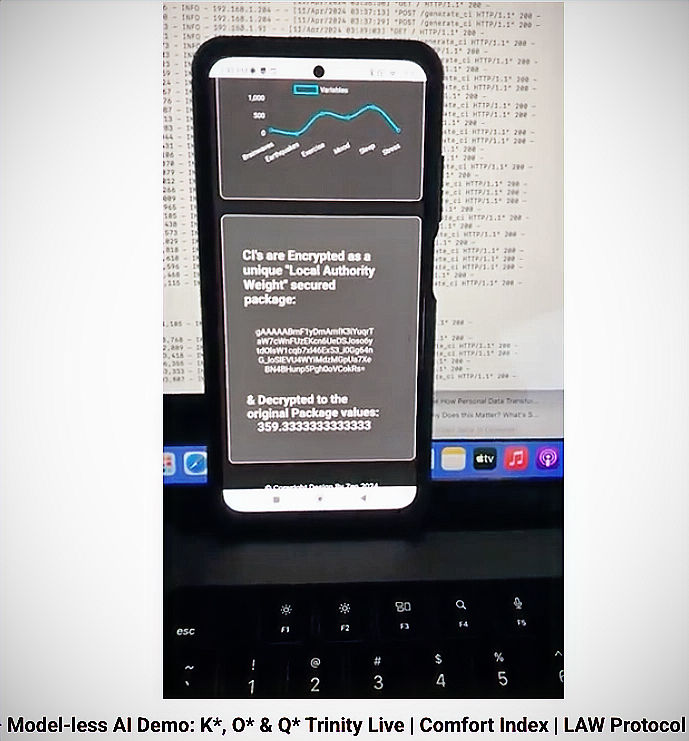
"AI Without the Model" — [00:02:25]
A phrase was used in the demo that deserves precision: "AI without the model."
This does not mean the system cannot use a language model. It has a direct interface built to connect with LLMs — and in the current version of Ask Omega*, Claude serves as the reasoning engine when called upon. The integration is deliberate and governed.
What it means is that the core intelligence does not depend on the model. The K*, O*, Q* Trinity runs, calculates, encrypts, decrypts, and establishes consensus entirely independently. The model is an optional layer that can be invoked. It is not the foundation.
Most AI systems today are built the other way. The model is the foundation. The governance is the optional layer. We built it right. Governance first. Model second. That sequence is not a detail. It is the entire thesis.
What I Said at the End — [00:04:03]
The demo was wrapped up by describing the architecture as decentralised AI operating entirely locally on a mobile device — designed to cultivate what was called a hive mentality: distributed networks that collectively solve complex problems by safely interchanging knowledge.
Then I waved goodbye and asked people to subscribe. 25 people watched.
What Has Changed Since April 2024
The architecture has not changed. The sequence has not changed. The philosophy has not changed.
What has changed: The Comfort Index is now formalised at ComfortIndex.org.
The Clinical Intelligence Ecosystem has a Node-1 deployment pilot at a surgical practice in Nelson, New Zealand — with Dr. Phil, orthopaedic surgeon, as clinical validation partner.
Ask Omega* is at v0.9.8, rated 9.872/10, production grade. The LAW protocol that appeared on a phone screen in April 2024 is the same one running in the current clinical system. (We changed the format to 1-10 with two decimals from 1-1000)
The target is 1,000 founding Pro Users by Christmas 2026.
The lineage is direct and unbroken.
Why I Am Telling You about model-less AI governance now?
Because the founding account matters. Not for sentiment. Not for origin-story marketing. Because in a world where every AI company announces governance after the fact, there is a working demo with a timestamp and a Python server proving ours came first.
25 views. April 20, 2024. HTTP/1.1 200. Real responses.
The definition was dissolving. The instrument was built. And it improved.
Omega* Sensing is part of the Omega* Unified Ecosystem, developed by Design By Zen, an NZ-based AI Lab. Omega* is the algorithmic engine beneath the ecosystem. SHE ZenAI is the brand of a governed clinical intelligence framework designed for high-trust domains where evidence, not confidence, is the currency of care. Version 1.0, April 2026.


Comments